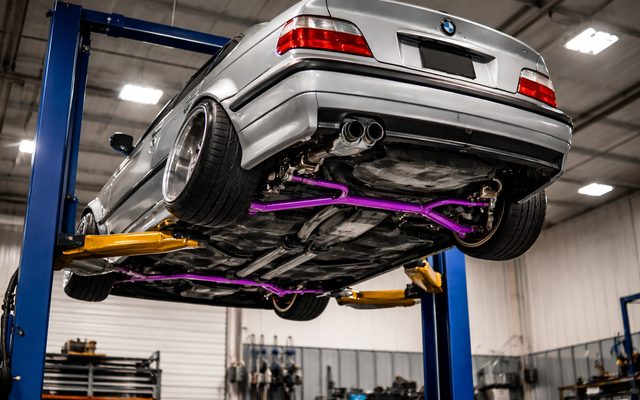
Inside the high-stakes arena of contemporary professional sliding, success is far more than exclusively a result of brute torque or pilot aggression. Rather, it is now a complex engineering challenge that demands a painstaking fusion of choosing a proven vehicle platform, equipping it with the most precise performance parts, and, most importantly, grasping its dynamic characteristics on the course through advanced suspension tuning applications. This exhaustive handbook functions as your roadmap starting from the initial idea of a competition vehicle right through to the last data-informed adjustments that transform a strong car into a consistent podium finisher. We will examine in detail the precise engineering of car suspension tuning, showing how a advanced suspension tuning tool like GripDial removes guesswork and delivers exceptional insight into your car's actual dynamics.
The bedrock of any great drift machine is, undoubtedly, the base vehicle itself. Certain cars have attained renowned reputation within the international oversteer culture due to their built-in balance, robust design, and the enormous availability of specialist components available. Picking the correct platform is the primary and most important choice a builder will make. For instance, the BMW's E36 3 Series is universally acknowledged as one of the best balanced cars for drifting of history. Its near-perfect 50/50 weight distribution, coupled with a RWD layout and robust inline-six motors, establishes a chassis that is at once accessible for newcomers and extremely effective in the hands of a expert driver. The successor of this lineage, the E46 model BMW, builds upon these qualities with a even more sophisticated frame, broader wheel track for greater stability, and still more steering angle as standard from the factory. A different powerful option in the professional circuit is the C6 generation Corvette.
This muscle-derived track weapon brings a distinctive combination of strengths to the sliding sport, featuring a light aluminium chassis, a rear-mounted gearbox and differential unit that aids in an ideal balance, and the immense thrust of a big LS V8 motor. This blend transforms it into an utter force on track, able of initiating and maintaining continuous slides with seemingly easy use of throttle. For drivers seeking exceptional performance per dollar, the Nissan 350Z rises above as a prime choice. It is delivered from the factory with a rigid chassis, a competent original limited-slip differential, and the free-revving VQ series powerplant that delivers plenty of horsepower and torque for learning and moving up in the sport. Its newer version, the Nissan 370Z, presents more improvements in chassis stiffness, handling precision, and outright engine power, cementing its position as a popular choice among serious drivers. Further iconic vehicles that warrant attention include the lightweight unique FC generation RX-7, the ever-present S13 Silvia/240SX, the V8-powered Ford SN95, the electronic-equipped BMW E90, and the compact yet unbelievably playful and instructive MX-5 Miata. Each of these platforms provides a different palette of characteristics, complexities, and potentials, but they all possess the basic ingredients essential to become a capable drift car.
However, choosing the right car is only the starting point. To access the full potential of any of these cars, significant upgrades to the steering geometry and damping and springing systems are utterly essential. This is where the world of precision drift-spec hardware enters critical focus. The most most transformative upgrade for a serious competition vehicle is the fitting of a maximum-angle steering angle kit. These engineered kits, like those developed by performance brands like SLR Speed, are designed to dramatically enhance the vehicle's available steering angle. A OEM road car is severely constrained in how far its steering tires can turn, a safety limitation for daily driving. In drifting, conversely, extreme opposite lock is frequently required to manage and maintain a angle. An steering kit replaces the OEM steering knuckles, linkages, and sometimes control arms with parts that allow the steered wheels to achieve steering lock in excess of 70 or even 80 °, versus a typical OEM limit of around 40 to 50 degs.
This vastly increased capability gives the pilot with exponentially greater control during a drift, enabling it to be considerably easier to initiate a drift, sustain it through a long corner, and switch fluidly from one side to the opposite. The difference in drivability is absolutely transformative. Combined with a correctly selected steering kit is the every bit as critical upgrade to the vehicle's damping system. Store-bought or including high-end sport adjustable suspension are simply not intended for the unique and harsh needs of drifting. A drift-spec system of adjustable dampers is of utmost importance. These engineered coilovers feature custom damping rates and spring strength that are tuned for the rapid mass transition that is inherent of sliding. When a operator begins a angle, the vehicle's weight is thrown forcefully to the outer of the bend. Proper performance suspension handle this movement in a predictable fashion, allowing the chassis to stabilize rapidly and providing the driver precise feedback through the controls and driver's seat. They additionally allow for accurate adjustment of ride height, shock absorber stiffness, and corner weighting, which are all fundamental aspects of dialing in the vehicle's dynamics to a given circuit or driving approach. In combination, a high-quality steering angle kit and a correctly chosen pair of drift-spec adjustable dampers are the undeniable physical foundation upon which all future tuning is built.
Once the essential hardware is in place, the subsequent essential phase in the project is the precise adjustment of the car's wheel angles. This is the domain of car suspension tuning, a procedure that can seem intimidating to the beginner but is, in reality, the defining factor to turning a collection of high-performance parts into a unified and controllable machine. The most discussed element of tuning for drifting is certainly camber. Camber angle is the tilt of the wheel in relation to the perfectly straight axis when looked at from the front of the car. If the top edge of the tire is tilted towards the car, this is referred to as camber-in. In drifting, inward-leaning wheels on the front wheels is generally used and is seen as essential. The logic is deeply linked to physics.
When a car is going around a bend at extreme angles, the chassis leans to the outside of the turn. This chassis roll forces the outer front tire to lose its optimal contact patch with the track surface. By adding inward lean, the tire is pre-angled to account for this tilt. As the chassis leans into the bend, the outside front tire becomes more upright on the asphalt, optimizing its bite at the critical time when it is most required for steering authority. Typically, front axle camber settings for a competition sliding vehicle vary from approximately -3 degrees to as high as -5 degrees or even greater, based on the details of the chassis setup, compound selection, and pilot style. The rear wheels also employ inward lean, but car alignment tuning the values are usually more conservative and less aggressive than the front axle. Too much negative camber at the back can result in the chassis excessively loose and hard to predict on throttle application, as it shrinks the available tire footprint of the driving tires during straight-line acceleration. Hence, rear camber settings are commonly in the ballpark of -1 degree to -3 degrees, striking a precise compromise between offering enough lateral traction to aid in starting and holding the angle while still preserving effective traction for power-down the turn. Camber is merely one element of the more complex suspension geometry puzzle, which additionally involves toe angle, self-centering steering, and steer correction modification.
Toe angle is the direction of the tires when viewed from a bird's-eye view. Toe-in means the leading edges of the tires are closer together than the trailing edges, while toe-out means the reverse. For oversteer, a small amount of front axle negative toe is often employed to improve the turn-in handling feel, making the car feel more nimble and ready to begin a slide. Rear toe angle is typically set to zero or a extremely minute amount of positive toe to promote predictability under throttle. Caster is the frontwards or backwards tilt of the kingpin axis when observed from the side of the vehicle. Positive positive caster improves self-centering and high-speed confidence, and it additionally adds to negative camber increase during steering, which is extremely beneficial. Adjusting these settings is a detailed interplay where a change to one setting can and often will influence the others. The traditional method for tuning a car's alignment for drifting has long been a tedious process of trial and error. A driver or crew would make a modification based on experience, test the chassis on track, depend on the operator's subjective perception and comments, and then apply an additional tweak. This process would continue again and again until the vehicle felt "good" or the available track time ended. This approach is not only exceptionally wasteful in terms of man-hours and costs, but it is additionally inherently flawed.
Human sensation is a famously subjective metric, influenced by many variables such as fatigue, evolving track surfaces, ambient heat, and simply the mindset of the driver on that specific day. What feels "tail-happy" on one run might feel "tight" on the next pass, resulting in contradictory feedback and frustrating adjustments. This traditional limitation in chassis setup is precisely where modern engineering tools has intervened to revolutionize the process.
The rise and adoption of specialized vehicle dynamics tools has ushered in a new era for engineering and perfecting professional sliding vehicles. These systems, represented by groundbreaking products like data acquisition tools, operate by actively measuring the real-time mechanical performance of the vehicle as it is operated on the course. As opposed to depending on subjective feel, these drift suspension tuning guide systems collect measurable data on essential variables such as damper compression and extension, individual tire rotation, lateral and longitudinal g-forces, steering angle, and throttle and brake application. This raw telemetry is then interpreted by powerful applications that can visualize and analyze the metrics in a actionable way. For the first time ever, drivers and crews can see precisely what the car is performing at each moment of a slide. This function revolutionizes the entire alignment optimization process. Consider the aforementioned task of optimizing the front axle negative camber for a given chassis. Rather than introducing a adjustment from -3 degrees to -3.5 degrees and then running many runs to try and "perceive" a difference, a telemetry system can give instant and irrefutable information. The application can show in a chart how the wheel's loading is drift suspension tuning guide behaving during the critical moments of a drift: initiation, holding the angle, and transition. It can reveal if the existing value is permitting the outside front tire to keep maximum grip or if the tire is over-stressed on its outer shoulder.
The tool can subsequently make fact-based suggestions for adjustment. Perhaps the data reveals that the tire is even overloading its edge at -3.5 degrees of negative camber, suggesting that a move towards inward lean, say -4 degrees, might be beneficial. Alternatively, the data might reveal that the tread is not reaching heat or that the inner shoulder is wearing excessively, which could suggest that there is too much inward lean and a modest lessening back to -3.2 degrees would be more efficient. This standard of granularity and actionable insight was literally unattainable in the time of exclusively seat-of-the-pants adjustment.
The benefit of using a advanced suspension tuning tool goes well beyond merely optimizing camber. It becomes an invaluable damper adjustment manual that is specific to your particular chassis. When fine-tuning the damping settings on your suspension, instead of using imprecise tips or replicating another team's settings, you can use the telemetry to analyze how the car is reacting in response to your tweaks. The tool can show the suspension travel path over a run, showing if the shocks are controlling the weight transfer optimally or if they are allowing the vehicle to bounce too much after a transition. It can aid in pinpointing challenges like excessive compression or losing droop, permitting you to apply educated adjustments to helper springs, damping rates, or ground clearance. This approach extends equally to the intricate task of corner balancing. In addition to camber, the software can offer analysis into how changes to toe and caster angle are influencing the chassis's balance during various parts of a slide. For example, it can help you to find the best amount of front axle toe out for your particular steering rack setup and driving approach by showing the response time of turn-in reaction and the stability of the chassis at lock countersteer. This transforms the tool an extremely effective performance optimization handbook that is constantly calibrated by the real-world behavior of your own car on the track. It shifts the whole endeavor from a mysterious craft into a scientific development procedure.
Moreover, the utility of a tool like data acquisition is in no way restricted to expert engineers with extensive resources. For the club-level enthusiast, it functions as an amazing equalizer. It practically provides the tuner with the analysis of a full-time race engineer without the typical expense. It speeds up the tuning process by giving definitive answers to problems that would traditionally take countless track days of trial and error to solve. A builder can learn how their individual chassis reacts to different settings, building a deeper understanding of vehicle dynamics in the endeavor. It additionally makes accessible professional chassis dynamics principles, enabling anyone with the ambition to optimize their car to do so in a efficient and successful way. This is particularly valuable in a activity like sliding, where tuning expertise has historically been a highly secretive asset among professional drivers. Today, that power can be in the hands of any motivated enthusiast.
In the final analysis, the journey to constructing and tuning the ideal high-performance drift machine is a multi-stage mission that smoothly integrates proven mechanical wisdom with 21st-century digital tools. It commences with the wise pick of a capable chassis, then built upon the installation of essential drift-spec components like maximum-angle steering angle kits and expertly valved drift-spec adjustable dampers. The journey then advances into the detailed stage of chassis dynamics adjustment, where settings like camber angle, toe setting, and caster angle are meticulously configured to complement the vehicle's upgraded capabilities and the operator's specific technique. The final step, and what genuinely differentiates the modern process from the traditional methods, is the adoption of a powerful drift telemetry software. This system removes the approximation and inefficiency of only feel-based setup by providing empirical, real-time information on how the vehicle is really performing. It serves as an incredible engineering partner, a comprehensive alignment optimization handbook, and a master performance analyzer. Together, this complete approach leads to that each and every aspect of the competition vehicle—from the selection of the car to the last tweak on the coilover—is perfected for maximum success on the track. It signifies the full maturation of the sport of sliding, connecting physical pilot talent with precise vehicle setup to create the ultimate dominant machines attainable.